See what your income covers
Start with the date you choose. See what comes in, what you plan to spend, and what the difference means for your savings.
Why use Retireomics
Retirement is a chain of connected decisions. When you change one part, the effect can reach your spending, taxes, Social Security, Medicare, and savings.
Retireomics gives you a transparent first pass. It shows what you entered, what it assumed, what changed, and where the calculation stops.
The problem we solve
Will income cover spending? When will savings need to help? What changes when Social Security starts? What happens to taxes and Medicare? And which parts still need a human conversation? Two tools can answer the same question differently because they answer those smaller ones differently —here is why retirement calculators disagree.
People, dates, income, savings, spending, health coverage, and the assumptions you want to test.
The model carries those inputs through the years so one change does not sit in isolation.
Each result shows its status and the assumptions, sources, or missing evidence behind it.
What the report helps you do
A useful result should answer the question you brought in. The report organizes the answer around cash flow, resources, timing, choices, and uncertainty.
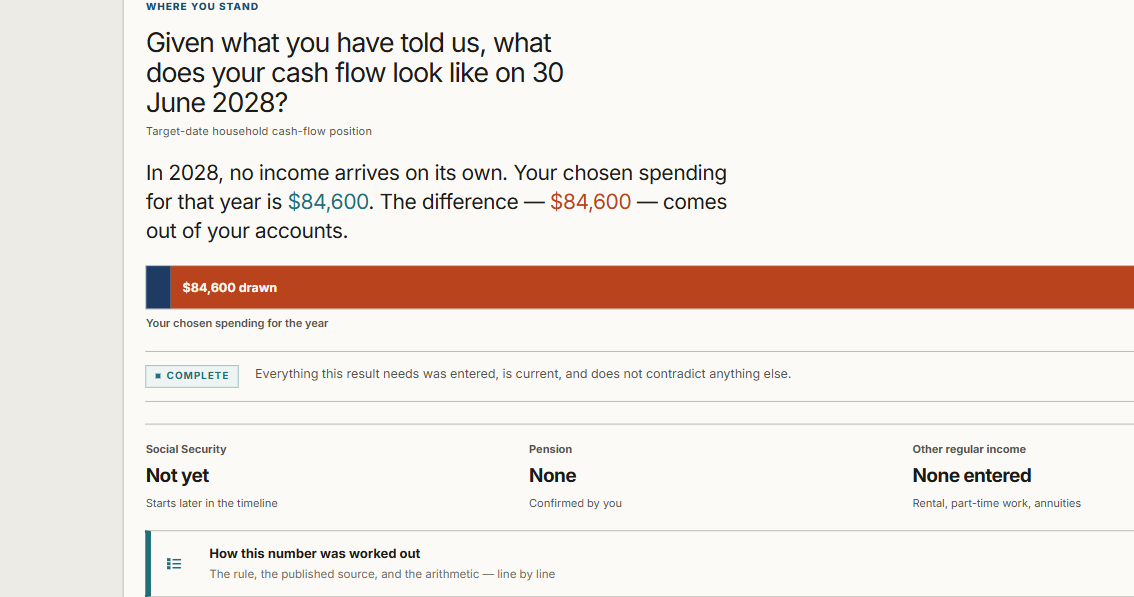
Start with the date you choose. See what comes in, what you plan to spend, and what the difference means for your savings.
Watch Social Security, pensions, taxes, Medicare, withdrawals, and savings change across the years instead of hiding behind one total.
Test a different retirement date, spending level, or claiming age while the other assumptions stay the same.
Use the report with your spouse or a professional so the conversation starts with the figures and assumptions that matter to you.
Compare one change
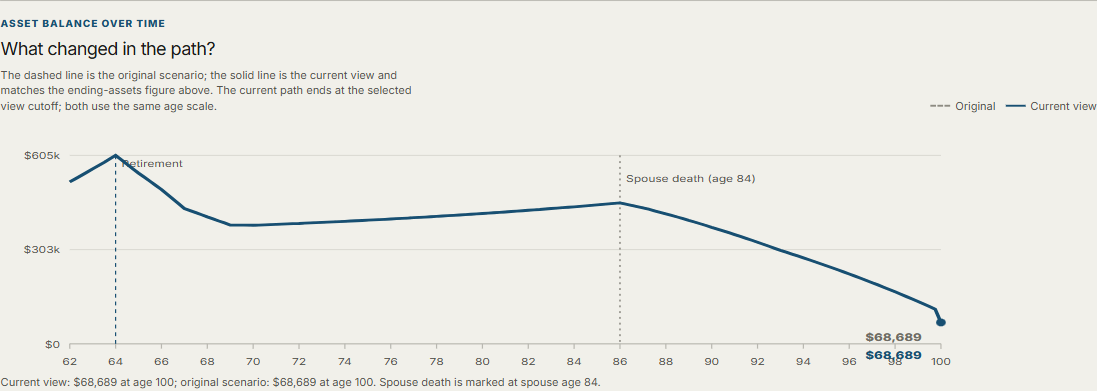
The model lets you compare cases you choose. Retire in one year or another. Spend more or less. Claim at a different age. The point is not to name a winner—it is to make the difference visible.
Same model. Same assumptions. One change you can discuss.
The benefit
You do not need to solve every retirement question alone. You do need a clear starting point, so the hour with a planner, tax professional, or spouse is about your decisions—not your data entry.
| When you are asking | The model helps you start with |
|---|---|
| Before you stop working | See how the retirement date changes the cash-flow picture. |
| Before choosing a Social Security age | Compare the modeled tradeoffs instead of treating each age as a separate guess. |
| Before changing spending | See what a higher or lower monthly expense changes under the same assumptions. |
| Before meeting a planner | Bring a report, a starting point, and clearer questions about what still needs personal advice. |
Know the edges
Every model has limits. Retireomics makes them visible so you can see what belongs in the model and what belongs in a conversation with a professional.
Read the full boundariesYour next step
Explore a worked example, or enter your own household details and see what the model gives you back.
Retireomics is an educational decision-modeling tool, not individualized financial, investment, tax, legal, Social Security, or Medicare advice. Calculator inputs are processed in your browser.